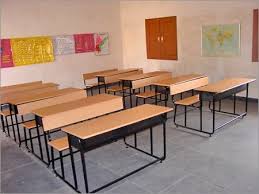
School furniture refers to specially designed furnishings used in educational environments such as primary schools, secondary schools, colleges, and training institutions. It includes desks, chairs, benches, laboratory tables, library shelves, teacher tables, storage units, and classroom accessories.
The main purpose of school furniture is to create a safe, comfortable, and efficient learning environment that supports students’ concentration, posture, and overall academic performance. Unlike general furniture, school furniture is designed to withstand heavy daily use, frequent movement, and varying student sizes while maintaining durability and ergonomic support.
Modern school furniture emphasizes functionality, safety, space efficiency, and affordability, making it suitable for large-scale educational institutions.
Definition of School Furniture
School furniture refers to durable and ergonomically designed furnishings used in classrooms and educational facilities to support teaching, learning, storage, and administrative activities.
Common wood materials used in school furniture include:
Tectona grandis Pinus radiata Quercus robur
These species are selected due to their strength, availability, and suitability for high-use environments.
Types of School Furniture
1. Student Desks and Chairs
Individual or dual seating arrangements
Designed for writing, reading, and classroom activities
2. Classroom Benches
Long seating units for multiple students
Common in primary and secondary schools
3. Teacher Desks and Chairs
Designed for instructors and classroom management
Often includes storage drawers
4. Laboratory Furniture
Includes lab tables, stools, and chemical-resistant surfaces
Used in science laboratories
5. Library Furniture
Bookshelves, reading tables, and study carrels
Designed for quiet learning environments
6. Storage Cabinets
Used for books, teaching materials, and supplies
7. Auditorium and Lecture Hall Seating
Fixed or foldable seating systems for large groups
Physical Characteristics of School Furniture
School furniture typically features:
Strong and durable construction for daily use
Ergonomic design to support student posture
Scratch and impact-resistant surfaces
Simple and functional designs
Lightweight or semi-heavy structures for easy movement
Smooth edges for student safety
Moisture and wear resistance (depending on material)
These features ensure long-term usability in busy school environments.
Manufacturing Process of School Furniture
The production of school furniture involves several stages:
1. Design and Planning
Furniture is designed based on age group, classroom size, and usage needs.
2. Material Selection
Wood, MDF, plywood, and metal frames are selected for strength and durability.
3. Cutting and Shaping
Materials are cut into standard dimensions for desks, chairs, and benches.
4. Assembly
Components are joined using screws, welding (for metal parts), or adhesives.
5. Surface Finishing
Surfaces are laminated, painted, or polished for protection and appearance.
6. Safety Finishing
Edges are rounded and smoothened to prevent injury.
7. Quality Testing
Furniture is tested for stability, load-bearing strength, and safety.
8. Packaging
Finished products are packed for transport and installation.
Tabulated Specification of School Furniture
Specification
Details
Product Name
School Furniture
Common Materials
Tectona grandis, Pinus radiata, MDF, metal
Product Type
Educational furnishing systems
Structure
Wood, engineered wood, metal frames
Surface Finish
Laminated, painted, varnished, or coated
Durability
High (designed for heavy daily use)
Ergonomics
Designed for student posture and comfort
Safety Features
Rounded edges and stable structure
Main Components
Desks, chairs, benches, tables, shelves
Maintenance
Easy cleaning and periodic tightening
Moisture Resistance
Moderate to high depending on material
Applications
Schools, colleges, training centers
Storage Conditions
Dry indoor environments
Packaging
Bulk-packed units or assembled furniture
Traceability
Manufacturing and institutional compliance records
Uses of School Furniture
School furniture is essential in educational environments:
1. Classrooms
Used for:
Student seating and writing
Teacher instruction and classroom management
2. Laboratories
Used for:
Scientific experiments
Practical learning activities
3. Libraries
Used for:
Reading and research
Study and academic work
4. Administrative Offices
Used for:
School management tasks
Record keeping and documentation
5. Lecture Halls
Used for:
Large group teaching
Academic presentations
6. Examination Halls
Used for:
Student assessments
Organized seating arrangements
Advantages of School Furniture
1. Enhances Learning Environment
Creates a structured and comfortable classroom setup.
2. Durable and Long-Lasting
Designed to withstand daily heavy use.
3. Ergonomic Design
Supports correct posture and reduces fatigue.
4. Safety-Oriented
Smooth edges and stable structures prevent injuries.
5. Cost-Effective
Suitable for large-scale institutional procurement.
6. Easy Maintenance
Simple cleaning and repair processes.
Economic Importance
School furniture contributes to global development by:
Supporting education infrastructure growth
Creating employment in furniture manufacturing industries
Driving demand in construction and educational sectors
Encouraging mass production and supply chain efficiency
Supporting government and institutional procurement systems
It is a key segment of institutional furnishing markets.
Environmental Considerations
Sustainable school furniture production involves:
Use of certified and plantation-grown timber
Recycling of wood-based materials
Low-emission paints and adhesives
Use of engineered wood to reduce deforestation
Efficient manufacturing with minimal waste
Eco-friendly school furniture supports sustainable education infrastructure.
Storage and Handling Guidelines
To maintain quality:
Store in dry, ventilated environments
Avoid exposure to moisture and direct sunlight
Handle carefully to prevent scratches or damage
Assemble according to manufacturer guidelines
Regularly inspect for loose joints or wear
Proper care ensures long service life.
Quality Control Standards
High-quality school furniture must meet:
Structural strength and stability tests
Ergonomic compliance standards
Safety requirements (smooth edges, stability)
Surface durability tests
Load-bearing capacity standards
Environmental and material safety certifications
Conclusion
School furniture is a vital component of educational infrastructure, designed to enhance comfort, safety, and learning efficiency in classrooms and institutions. Manufactured using durable materials such as Tectona grandis, Pinus radiata, and Quercus robur, it ensures long-lasting performance even under heavy daily use.
From classrooms and laboratories to libraries and lecture halls, school furniture supports the entire learning process by creating organized and productive environments. As education systems continue to expand globally, demand for durable, ergonomic, and cost-effective school furniture continues to grow.
In essence, school furniture is not just classroom equipment—it is a foundational element that shapes learning experiences, supports student development, and strengthens educational systems worldwide.