Within the global retail sector, packaged honey products represent the final transformation of apiary commodities into consumer-ready, shelf-stable, and branded goods. The packaging stage is not merely a logistical necessity; it is a critical biophysical barrier. Honey is hygroscopic—meaning it constantly seeks to absorb ambient moisture from the air—and if the packaging fails, the honey will absorb enough water to cross the threshold that permits osmophilic yeast fermentation.
The industrial packaging of honey is a sophisticated exercise in fluid viscosity control, aseptic filling, and material science. To deliver a consistent consumer experience, manufacturers must bridge the gap between high-volume, automated production lines and the delicate, variable physical behavior of different honey varieties.
Defining Packaging Modalities and Retail Formats
The honey industry categorizes its retail packaging based on the target consumer use-case, ranging from industrial bulk supply to premium artisanal gifting.
                                  ┌──► Squeeze/Drip Units (PET/LDPE; mass market consumption)
[Consumer Honey Packaging] ───────┼──► Glass/Rigid Containers (Jars; premium/reusable)
                                  └──► Industrial/Foodservice (Pails/Drums; bulk integration)
1. Drip-Control Squeeze Packaging (PET/LDPE)
The dominant format for modern mass-market retail. These containers use Polyethylene Terephthalate (PET) or Low-Density Polyethylene (LDPE) equipped with specialized silicone-membrane valves. These valves prevent the “stringy” tail of honey from dripping after the bottle is squeezed, solving the primary consumer complaint of sticky, messy honey storage.
2. Glass and Rigid Jar Packaging
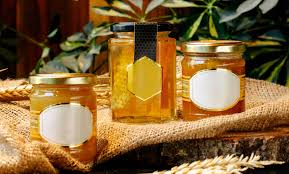
The traditional gold standard for high-end raw, creamed, or artisanal honey. Glass provides a completely inert, zero-permeability barrier against moisture and oxygen, ensuring the aromatic volatile compounds—which define a specific honey’s floral origin—do not escape during long-term storage.
3. Bulk Foodservice and Industrial Packaging
High-volume industrial manufacturing uses food-grade, high-density polyethylene (HDPE) pails or steel drums coated with food-safe epoxy resins. These are engineered for high-speed automated decanting in industrial bakeries or confectionery plants where honey is blended as a functional ingredient.
Technical Specifications: The Barrier Challenge
To maintain the shelf-life standards expected in retail distribution, packaging materials must be certified to protect the honey against environmental moisture and oxidation.
Packaging Specification
Industrial Baseline
Importance
Water Vapor Transmission Rate (WVTR)
$< 0.5 text{ g/m}^2/text{day}$
Prevents moisture absorption & fermentation
Oxygen Transmission Rate (OTR)
$< 5.0 text{ cm}^3/text{m}^2/text{day}$
Prevents lipid oxidation and color darkening
Tamper-Evident Integrity
Induction-sealing / Shrink-band
Guarantees consumer safety and authenticity
Material Migration Limits
FDA/EU Food Contact Compliant
Prevents plasticizers from leaching into honey
Torque Specification (Caps)
12 to 18 inch-pounds
Maintains seal without stripping thread
Light Transmission (UV)
$< 10%$ (For premium amber glass)
Prevents photo-oxidation of enzymes
The Industrial Filling and Sealing Sequence
High-speed honey packaging lines are engineered to manage the product’s high viscosity (thickness) while preventing the entrapment of air bubbles, which can cause oxidation and unsightly foam layers.
Honey is gently warmed to a stable 30°C to 35°C inside holding vats. This standardized temperature ensures the honey maintains a consistent, pumpable viscosity, allowing for high-precision volume metering into jars without dragging or cavitation.
Automated fillers use positive-displacement pistons or rotary lobes. Unlike vacuum fillers, these systems force an exact, non-compressible volume of honey into the container, eliminating air pockets and guaranteeing that every unit meets the labeled net weight.
3.Surface Foam Vacuum Extraction:De-Aeration.
Immediately after filling, containers pass through a vacuum-suction station. This system gently pulls the surface layer of foam (trapped air micro-bubbles) off the top of the honey, ensuring the final product looks bright and crystal clear through the bottle wall.
4.Induction-Seal Closure:Airtight Integrity.
Caps lined with a multi-layered aluminum foil induction seal are applied. As the jars pass through an electromagnetic coil, the foil heats up and creates an airtight, hermetic bond to the container rim, permanently locking out moisture and oxygen.
5.Sleeve-Band Application:Anti-Tamper.
A heat-shrinkable PVC or PETG plastic band is applied over the cap and neck. The unit passes through a steam-shrink tunnel, locking the band in place. This provides a visible, tamper-evident safety seal required by modern retail food safety standards.
6.Weight and Integrity Check:Final Audit.
Every unit moves across an automated dynamic check-weigher. Jars that fall below the declared net weight are automatically diverted. A final visual inspection system scans the labels to verify placement and readability before the units are packed into shipping cases.
Consumer Storage and Structural Longevity
While industrial packaging is engineered to lock in safety, the honey’s physical stability post-purchase depends on the consumer.
The Crystallization Trap: Even in a perfect seal, honey will eventually crystallize. This is a physical state change, not a sign of spoilage. Consumer-grade packaging often features a clear “re-liquefying” instruction, emphasizing that placing the jar in a warm water bath (below 45°C) will safely melt the crystals without destroying the enzymes.
The Moisture Ingress Risk: Once the induction seal is broken, the packaging’s ability to prevent moisture ingress is significantly reduced. Consumers are advised to store honey in a cool, dark environment ($15^circtext{C}$ to $20^circtext{C}$) to minimize the rate of HMF (Hydroxymethylfurfural) accumulation, which is the primary chemical marker of heat-induced degradation and age.
Conclusion
Packaged honey products represent a primary interface between high-precision apiary processing and the final consumer experience. By utilizing advanced induction-sealing technology, viscosity-controlled metering, and moisture-barrier materials, packaging plants successfully freeze the biological state of the honey, ensuring it remains safe, clear, and flavorful from the processing line to the pantry.
As global retail trends prioritize sustainable materials, such as bio-based PET and infinitely recyclable glass, the honey packaging sector continues to evolve, balancing environmental responsibility with the strict moisture-exclusion demands of this complex, hygroscopic commodity.